Welcome to Crooked Forest, Gryfino, Poland
No pre-war German records regarding the planting or pruning of the forest have ever been found, meaning that Krzywy Las remains—officially and to this day—a mystery in the eyes of the very foresters who tend to it.

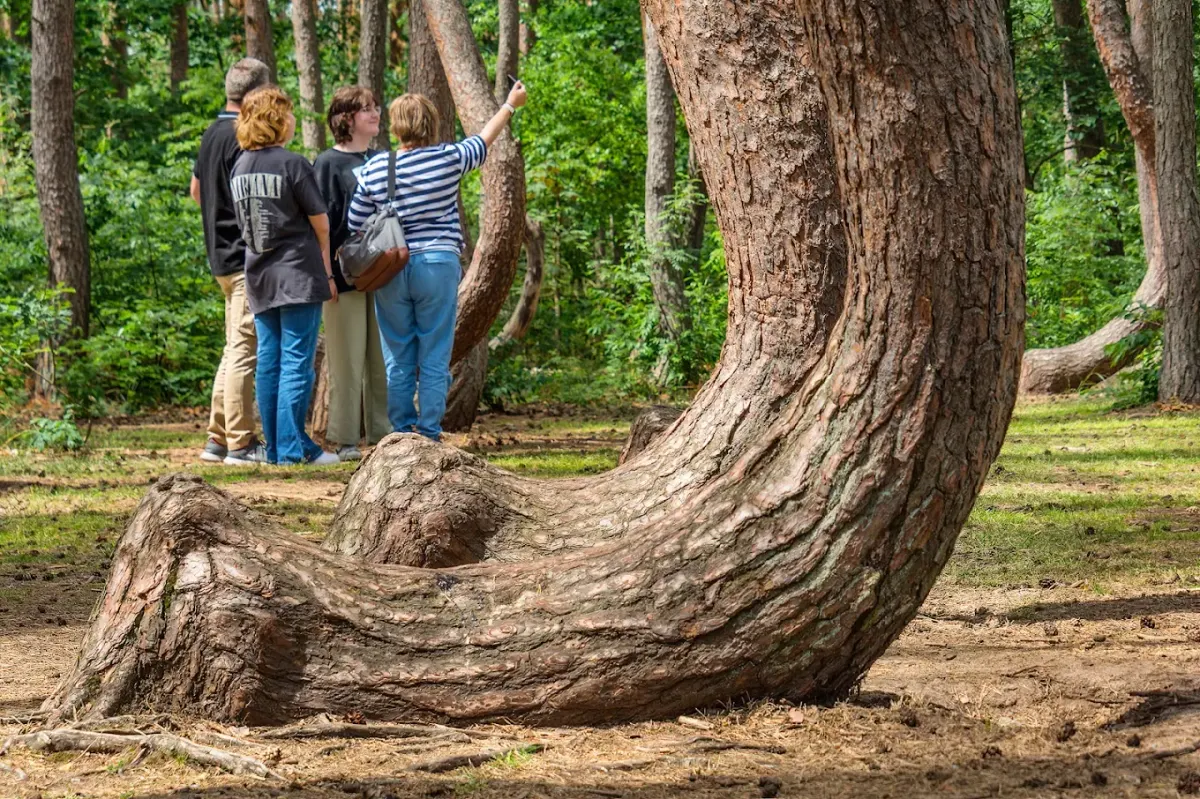
Nature often unfolds in ways that seem impossible for the human eye to explain. But if we stop to think about it, perhaps it is simply a natural phenomenon that shouldn't be questioned. The Crooked Forest in Gryfino, Poland is one of those mysterious places.
There is a quiet path near the Oder River where the ground beneath your feet shifts as you walk.
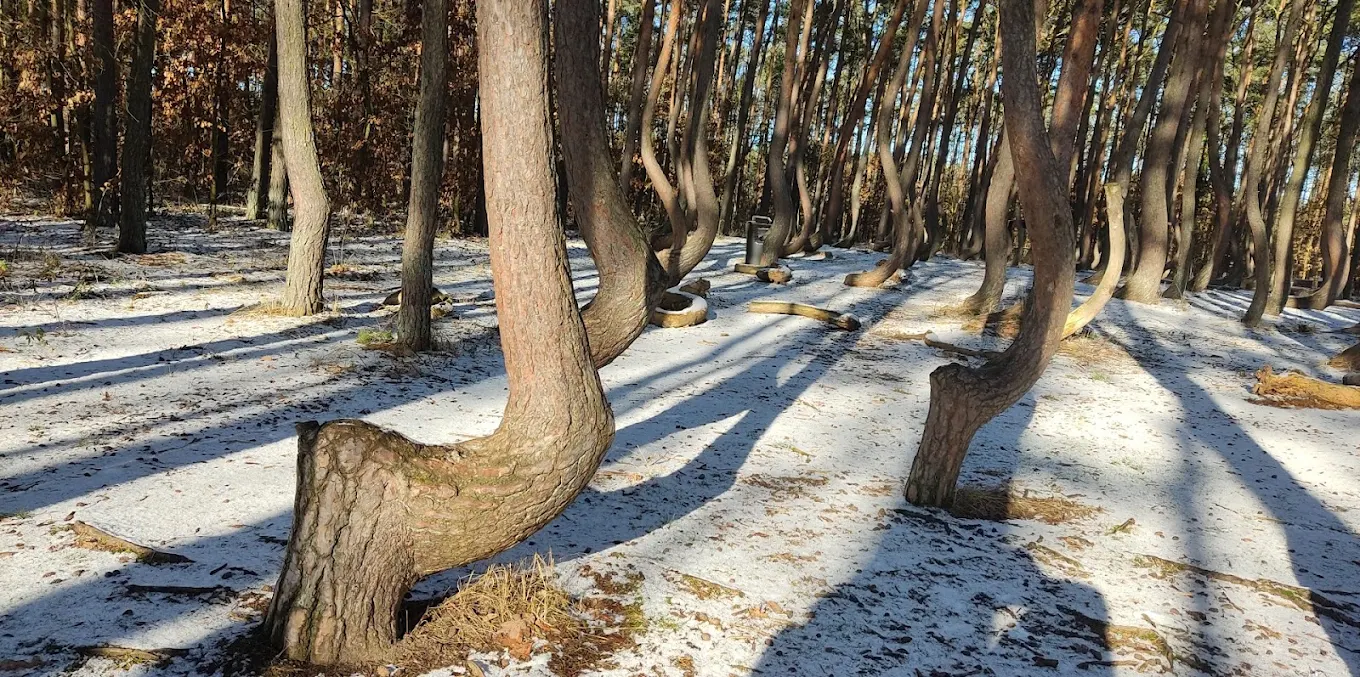
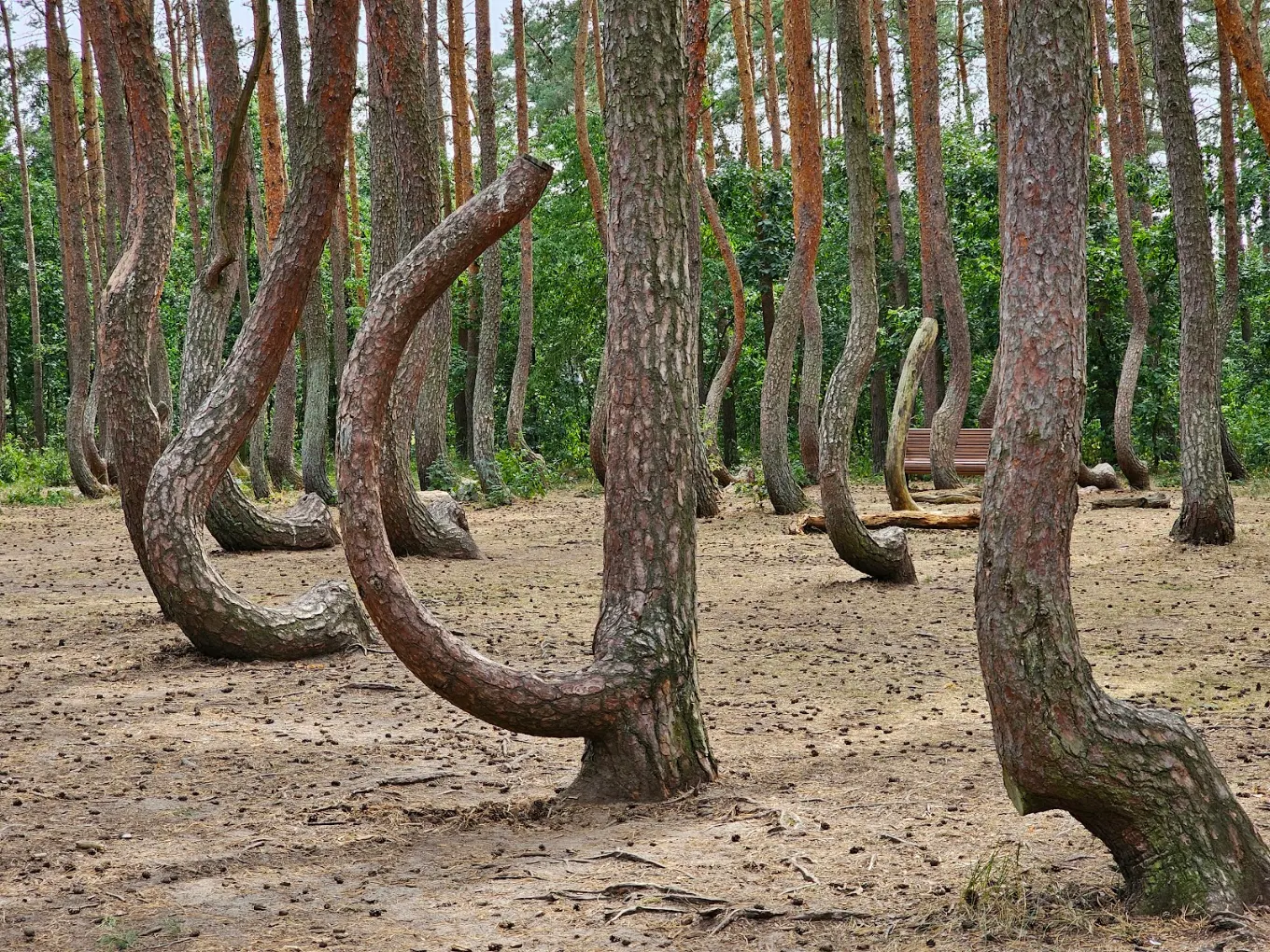
Gradually, you begin to spot pine trunks featuring a peculiar curve right at the base. The curves of these 400 trees point northward before straightening out again just a few centimeters up.
Let me introduce you to Krzywy Las—the Crooked Forest—nestled within the village of Nowe Czarnowo in the West Pomerania region of northwestern Poland.
Its size—covering half a hectare at its core—belies its immense popularity within the country. Locals call it "a riddle wrapped in bark."
Rediscovering Crooked Forest in Gryfino, Poland
The pine trees are believed to have been planted in 1934—a time when this region still belonged to Germany and the town of Gryfino was known as Greifenhagen.
Then came World War II, the redrawing of borders in 1945, and the relocation of German settlers to the west.
When Polish foresters and locals took over the area, they rediscovered the Crooked Forest in Gryfino, Poland. The pines were already young trees that had grown with a curve that, to this day, seems inexplicable.
Today, Krzywy Las is legally protected by the Gryfino State Forest District (*Nadleśnictwo Gryfino*) as a natural monument (*pomnik przyrody*).
This district owns and manages the land, with protection formalized through a 2021 resolution by the Gryfino Town Council.
The trees are now 92 years old, and foresters openly admit that no document solving the mystery of the curves survived the war.
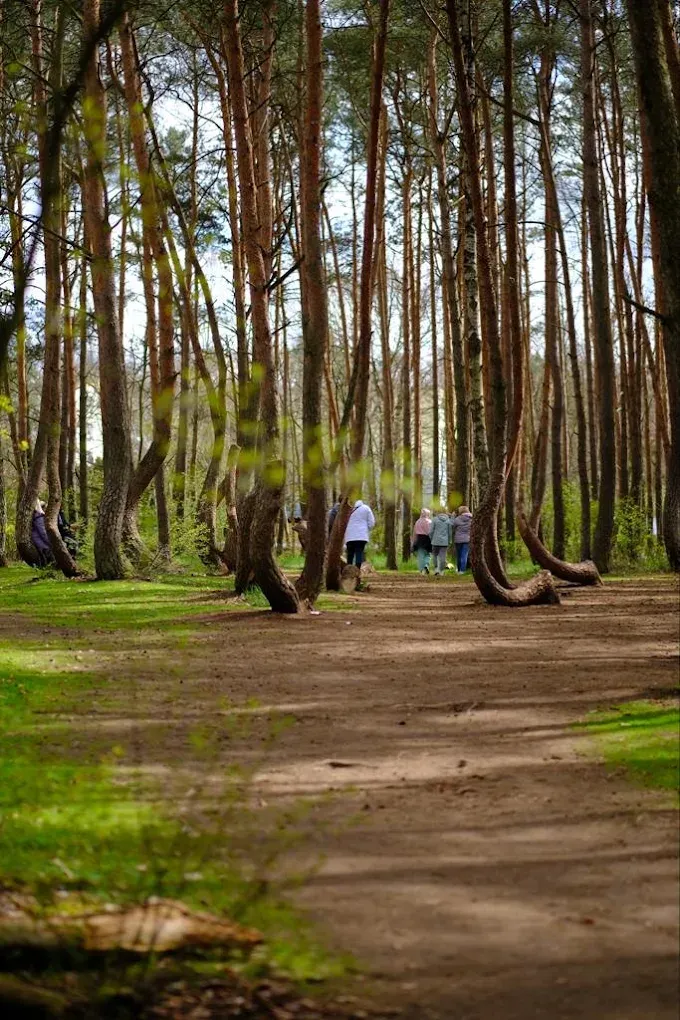
A Mystery or a Reality
As human nature has dictated throughout our history, humans always—without fail—seek an explanation for strange occurrences. The origin of the Crooked Forest in Gryfino, Poland is one such event.
Conspiracy Theories
- Human Design (the most widely accepted hypothesis): There was a time when curved wood was highly prized for manufacturing furniture, rocking chairs, sleds, barrels, and ship ribs, as it was far stronger than wood obtained by bending a straight beam. It is believed that young pine trees—aged six to ten years—were pruned near the base, leaving a single lower branch to continue growing. This branch would grow laterally before turning upward, effectively replacing the original trunk. The state forestry district supports this theory and links it to traditional woodworking practices.
- War damage: Some locals maintain that the shape of these trunks is due to Soviet tanks stationed here in 1945 crushing the young trees and permanently deforming them. Forestry experts dismiss this theory, asserting that tanks would have caused irregular damage rather than the nearly identical curvature found in all the trunks.
- Snow, soil, or natural forces: Others believe that heavy snowfall or shifting ground was responsible for bending the young trees. However, this does not explain why only this area was affected, as the surrounding pines grew straight.
- The supernatural and the extraterrestrial: —UFO landings and mysterious energy fields—are a running joke among locals and are even mentioned with a wink in the forest district’s own documents. Sometimes, visitors bring compasses, hoping to find anomalies. They find none.
To be honest, the official position is humble: the most probable cause is deliberate human shaping tied to timber use, but without surviving pre-war records, certainty is impossible. That unresolved edge is exactly what keeps people coming to the Crooked Forest in Gryfino, Poland.
Inside the Groove
Krzywy Las -Crooked Forest in Gryfino, Poland- consists of common Scots pines (*Pinus sylvestris*) that are notable for their shape.
Within the protected area, there are approximately one hundred deformed pines, with the 50 or 60 most curved trunks clustered in the center, surrounded by straight, ordinary pines.
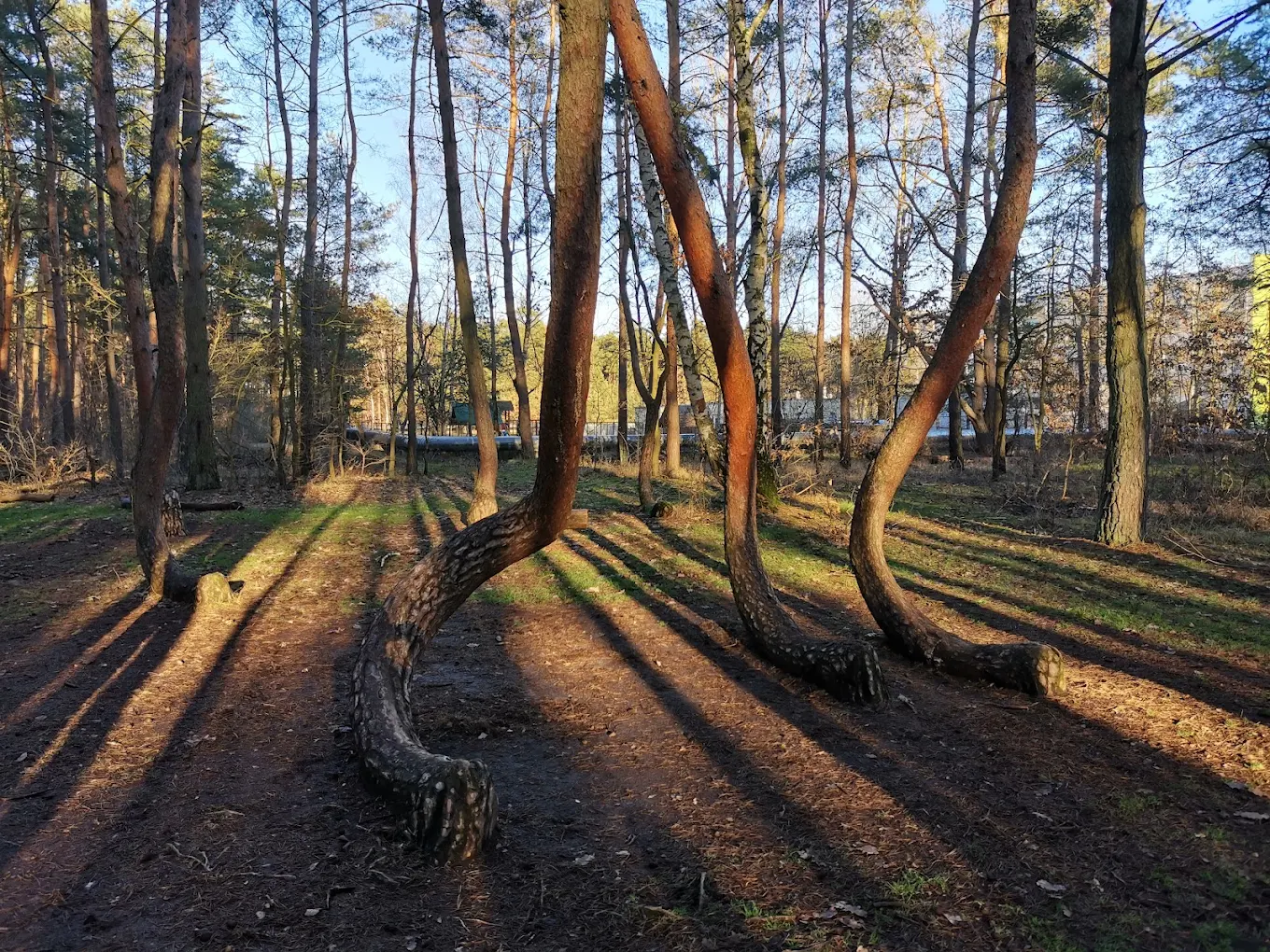
Each curve begins between 10 and 50 centimeters above the ground, leans northward for up to three meters, and then rises to a total height of between 11 and 15 meters.
As the original trees age—with some having already died or been removed for safety reasons—the Gryfino forestry district launched a revitalization project in 2020 in collaboration with the local municipality and the PGE energy company's foundation. In 2021, foresters planted 1,000 new pine saplings nearby—grown from cones collected from the original curved trees—to shape them later using the same pruning technique.
Researchers from the West Pomeranian University of Technology in Szczecin are now studying the site. Every summer, locals organize a season-opening event that includes a self-guided discovery trail.
As for the wildlife found along the trail, this area of Polish state-managed forest is home to typical woodland birds, roe deer, and small mammals, and forms part of the Lower Oder (Dolna Odra) river valley, located near the border with Germany.
Plan Your Visit
- Location: Village of Nowe Czarnowo, Gryfino municipality, West Pomeranian Voivodeship. Approximately 7 km from Gryfino and 35 km south of Szczecin, next to the Dolna Odra power plant.
- By car: Take the S3 expressway towards the coast, exit at Gardno towards Gryfino, and follow the signs through Nowe Czarnowo. The power plant's chimneys serve as a clear visual landmark.
- By train: Regional trains on the Szczecin-Gryfino-Kostrzyn-Zielona Góra line stop at Dolna Odra station, located a 15–20 minute walk from the forest.
- On foot or by bicycle: The red-marked riverside trail (known as the szlak nadodrzański) connects Szczecin with Mieszkowice and passes very close to the site.
- Cost and hours: Admission is free; as it is an open natural monument rather than an enclosed park, there are no fixed opening hours.
- Climate: West Pomerania enjoys a temperate transitional climate—between oceanic and continental—with cool winters and warm, moderate summers. Waterproof clothing is recommended at any time of year.
Best Time To Visit the Crooked Forest in Gryfino, Poland
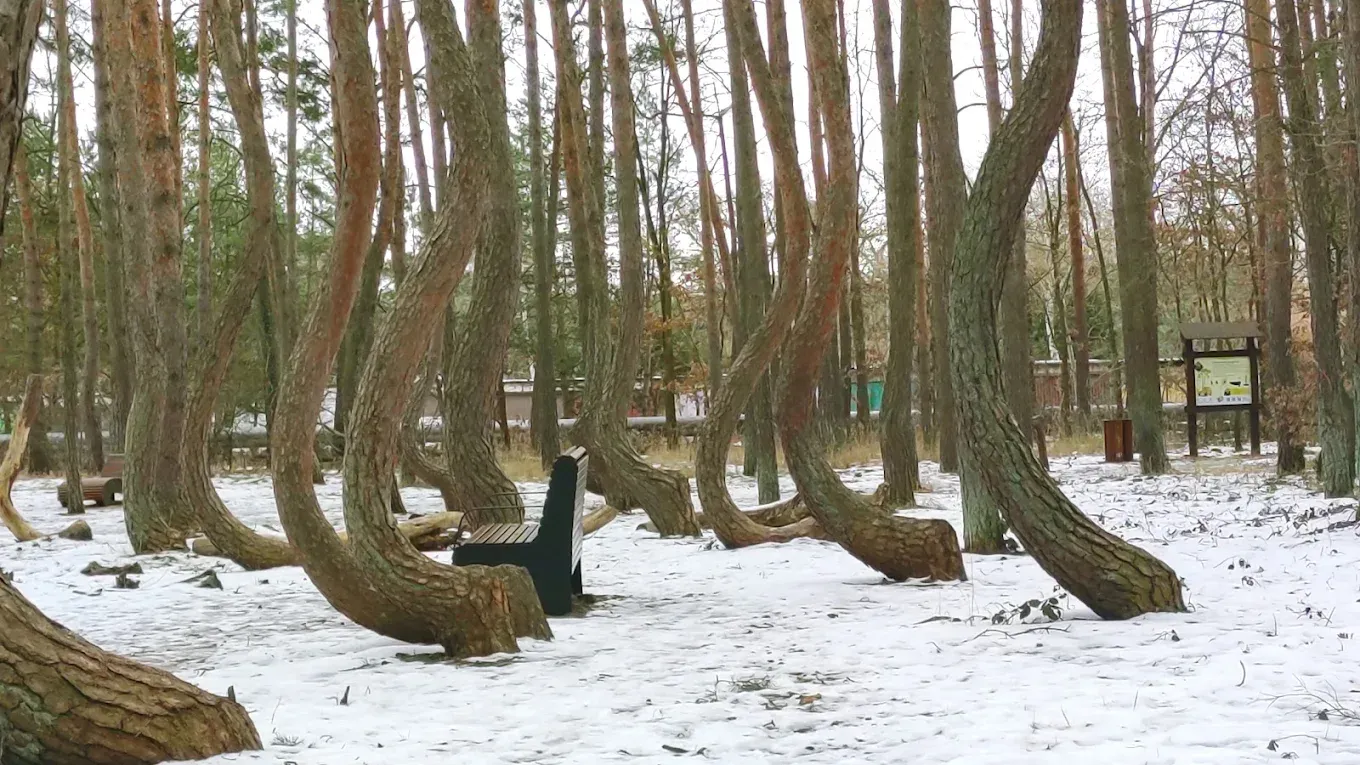
Peak season runs from June to August, when the small roadside parking area gets busy. For a quieter walk, visit during spring—when fresh green needles soften the trees' twisted shapes—or during the off-season months (autumn and winter), when frost or golden light creates an almost sculptural visual effect on the trunks. This allows you to enjoy the forest in solitude.
Just as supporting large mass media outlets is important, so is supporting independent and real journalism.
Plan V is an independent digital magazine dedicated to making your travels better experiences for both you and the destination.
Thank you for visiting; your support makes this possible.
FAQS
What is the mystery behind the Crooked Forest in Poland?
No one knows for certain why the Krzywy pines grew with a curve. It is believed that the forest was planted in the 1930s under German administration, but following the border changes of 1945, the original inhabitants left, taking the explanation with them. No documents survived to confirm how or why the trees were shaped that way, so the true cause remains officially unconfirmed.
What is the most famous forest in Poland?
Krzywy Las—the Crooked Forest near Gryfino, Poland—is considered the country's most famous and photographed forest curiosity. It is internationally renowned for its curved pine trunks. However, the Białowieża Forest is also one of the country's most popular forests—if not the most popular of all.
Why are the trees crooked in Poland?
The leading theory, supported by the Gryfino state forest district, holds that the young pine trees were cut or pruned near the base, leaving a lower branch that grew sideways before turning upward. This produced curved timber that was highly prized for the manufacture of furniture, boats, sleds, and barrels. There are other—less likely—theories, such as damage caused by tanks during the war or natural causes.
Why are 400 trees in Poland bent exactly to the north?
It is believed that approximately 400 pine trees were originally planted in the grove; however, today only about a hundred exhibit that pronounced curvature. They all lean toward the north due to a shaping method applied uniformly across the entire group, suggesting a deliberate technique rather than a random natural phenomenon.
 Pamela Herrera