Yakushima Island: Your New Must-See Destination in Japan
Yakushima Island in Japan, where the trees are older than civilization — and almost no one goes. Here's the guide for those who listen before booking.


In the heart of Yakushima Island, deep within a forest so humid it generates its own clouds, stands a cedar tree considered much more than just a tree. For the locals, it is a presence, a witness. The oldest living thing in Japan remains impassive while everything around it—kingdoms, religions, wars, centuries—unfolds. Jomon Sugi doesn't belong to Yakushima; Yakushima belongs to it.
In Shinto belief, ancient trees of unusual size or shape are considered yorishiro: objects in which a kami, a divine spirit, chooses to dwell.
Known among the locals as Jomon Sugi, a name derived from the Jomon period, the era of Japan's earliest known inhabitants, it is between 2,000 and 7,200 years old. Its age is not precise, as its immense trunk, marked by the passage of time, renders conventional measurements insufficient.
The Jomon Sugi remained unknown to the world until 1966, when Akira Miyawaki, a forestry worker, discovered it while inspecting trees slated for felling. He measured its circumference—16.4 meters at the base—and immediately understood that what he saw was indestructible.
His report halted the logging and spurred a conservation movement, leading UNESCO to declare Yakushima Island a Natural World Heritage Site in 1993.
The tree had survived millennia of storms, volcanic activity, and neglect. It also survived the chainsaw for just a few weeks.

Yakushima Island: A Place That Holds Every Climate at Once
Yakushima Island sits 60 kilometers south of the Osumi Peninsula, off the southern coast of Kagoshima Prefecture, in the far southwest of Japan.
Roughly circular — about 28 km across — it rises so abruptly from the sea that it holds eight mountain peaks above 1,800 meters, including Miyanoura-dake, the highest point in all of Kyushu at 1,936 meters.
This is what gives the island its nickname: the Alps of the Ocean. In 1993, Yakushima became one of Japan's first two UNESCO World Natural Heritage Sites.
The protected area covers 10,747 hectares — about 21% of the island — and was described by UNESCO as the best example of biodiversity in East Asia.
The ecosystem ranges from subtropical coastline to near-subarctic mountain peaks, hosting over 1,900 plant species and subspecies, 94 of them endemic.
The island is home to the Yaku deer and Yaku monkey, both subspecies unique to the island, and a turtle nesting beach designated as a Ramsar site in 2005. Annual rainfall in the interior reaches 10,000 mm — one of the highest in the world.

What makes Yakushima exceptional for slow travelers is this: it refuses to be consumed quickly. The cedar forests demand patience.
The trails require full days. The locals — fishermen, guides, mountain monks — carry a rhythm of life tied to rain and tides, not itineraries.
It is a place where slowing down is not a choice but a condition of entry.
Arriving Slowly, Entering The Forest (4 days Ultimate Guide)
Miyanoura port → Shiratani Unsuikyo Ravine
Day 1
Arrive by ferry into Miyanoura Port and resist the urge to rush. Rent a car here — buses run on the ring road, but the island's interior and western trails require your own pace.
Drive up to Shiratani Unsuikyo Ravine, a natural recreation forest between 600 and 1,050 meters above sea level. This is the landscape that Hayao Miyazaki used as inspiration for Princess Mononoke — moss-covered boulders, ancient cedars twisted into impossible shapes, rivers you can hear before you see.
Walk the trail to Taikoiwa (Drum Rock) at 1,050 meters for a sweeping view of the mountains. It takes about three hours one way.
In the evening, eat at a small restaurant in Miyanoura. Order tobiuo — flying fish — the island's signature dish, grilled simply or in a bento wrapped in bamboo leaves. Try a glass of local sweet potato shochu.

Day 2
Drive to Yakusugi Land, a UNESCO-adjacent forest with boardwalked trails leading to ancient cedars — Buddha Sugi, Futago Sugi, Sennen Sugi — each one named and carrying its own local legend.
The trees called Yakusugi must be at least 1,000 years old to earn the name; younger trees are simply called kosugi.
Stop at Senpiro-no-taki waterfall, a 60-meter drop onto a granite monolith — one of the island's most striking and accessible cascades.
End the day at Hirauchi Kaichu Onsen, a hot spring that emerges on the beach and is only accessible at low tide.
The sea fills around you as you soak. Check the tidal schedule before you go. It costs nothing.

The Oldest Tree in Japan, and Learning to Be Still
Jomon Sugi trek — the full day
Day 3
Leave before dawn. The Jomon Sugi in Yakushima Island hike from Arakawa Trailhead is roughly 22 km return, taking 8–10 hours. A permit is required, and the bus to the trailhead runs on a seasonal schedule — book everything in advance.
The trail follows a decommissioned logging railway through increasingly ancient forest before climbing to the tree itself: 25 meters tall, estimated between 2,170 and 7,200 years old (the Japan Tourism Organization cites 7,000 years as the local figure). You cannot touch it — a viewing platform keeps you at a respectful distance. Stand there quietly. The platform will feel small.
Bring all your food and water; nothing is sold on the trail.
On the way back, stop at the Wilson Stump — a hollow cedar felled in 1590 for a Kyoto temple. Inside, a small shrine. If you look up through the hollow at a certain angle, the aperture forms the shape of a heart.
This custom, rooted in ancient agricultural practices, also involves leaving breadcrumbs on the hearth—a remnant of the old tradition of entrusting seeds to the dead in hopes of a bountiful harvest.
The meal typically features bacalhau (salted cod), boiled potatoes, Portuguese cabbage, and eggs, followed by regional desserts.

Seibu Rindo road → Nagata beach → market & rest
Day 4
Rest your legs. Drive the Seibu Rindo Forest Road along the western coast — a 15 km route through primary forest, much of it within the World Heritage area. Stop the car and step in.
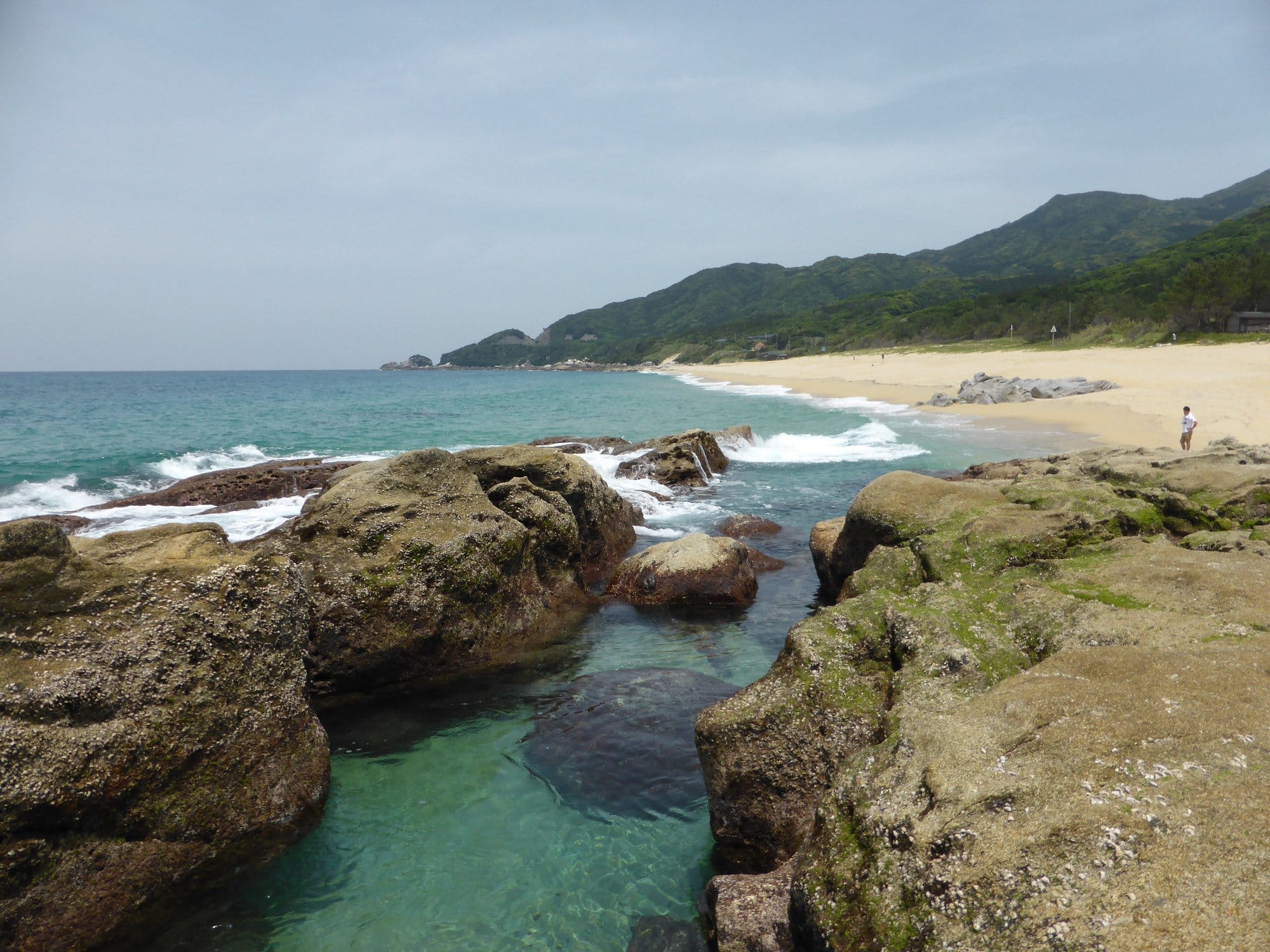
Banyan trees grow at the coastal edge; a thousand-year-old cedar canopy closes above. Wild Yaku monkeys are common along this road. Continue north to Nagata Inakahama Beach — from May to July, loggerhead sea turtles come ashore here to nest.
Yakushima Island is the largest loggerhead nesting site in the Northern Pacific, with some 10,000 landings per season.
In the afternoon, walk through Miyanoura's small port market. Buy local dried flying fish, pickled vegetables, and take a meal at a family-run teishoku restaurant. Ask what the catch of the day is. Eat it.
Rain is not the obstacle. It is the place.
Yakushima Island receives the highest annual rainfall in Japan — around 3,000 mm at the coast and up to 10,000 mm in the mountains. There is no truly dry season. Locals say it rains 35 days a month. What varies is the character of the rain.
- Spring · March–May
- Best for trekking. Relatively drier, wild cherry blossoms bloom in April. The rainy season begins after mid-May. Ideal for Jomon Sugi and Shiratani hikes.
- Summer · June–August
- Peak season for Japanese tourists. Humid, hot (up to 30°C coast), but milder in the mountains. June is the wettest month — 531 mm average. Turtle nesting season on Nagata beach.
- Autumn · Sept–November
- October is the busiest month of the year. Post-typhoon skies can be stunning. November brings excellent hiking with fewer people and warm coasts (~20°C) and cool summits.
- Winter · Dec–February
- Lowest tourist season. Accommodation cheaper. Temperatures are mild at the coast (11–14°C), and snow is possible at summits. Quietest, most local experience of the island.
The sweet spot for slow travelers is mid-April to early May, or November — both offer manageable weather, accessible trails, and fewer crowds than peak summer. Avoid June (heaviest rains) and Golden Week in May (crowded ferry and trails).

How To Arrive on Yakushima Island?
From Tokyo, fly to Kagoshima Airport (under 2 hours), then a connecting flight to Yakushima Airport (40 minutes). Alternatively, take a jetfoil ferry from Kagoshima Port — approximately 2 hours 35 minutes to Miyanoura Port.
Slower ferries are also available and cheaper. Rent a car at the port. The island has one ring road; driving the full perimeter takes about 3 hours without stops
I'm so glad you made it this far. Plan V is an independent magazine, and your donation allows me to continue doing this.
See you soon.
Thank you!
FAQS
How do you get to Yakushima Island?
Two ways. By air: fly to Kagoshima Airport from Tokyo (under 2 hours), then take a 40-minute connecting flight to Yakushima Airport.
By sea: the Toppy jetfoil ferry from Kagoshima Port reaches Miyanoura Port in about 2 hours and 35 minutes. Slower car ferries are also available and significantly cheaper — a good option if you want to bring a vehicle or simply ease into the journey.
Once on the island, rent a car. It is the only practical way to reach the interior trails and the western coast.
Is it worth visiting Yakushima Island?
For the right traveler, completely. Yakushima Island is a UNESCO World Natural Heritage Site, home to some of the oldest cedar trees on earth, endemic wildlife found nowhere else, and a coastline where sea turtles still nest by the thousands.
It is not a destination for resort holidays or packed itineraries. It rewards patience, physical effort, and genuine curiosity about the natural world. If those are your terms, few places in Japan — or the world — offer anything comparable.
Do people live on Yakushima Island?
Yes. Yakushima Island has a permanent population of around 12,000 people, spread across several small towns along the coastal ring road — Miyanoura and Anbo being the largest.
Islanders work primarily in fishing, forestry, tourism, and agriculture. The interior and mountain areas are uninhabited. Life on the island is closely tied to its environment: fishing seasons, tidal schedules, and mountain weather govern daily rhythms in ways that are immediately noticeable to any visitor who stays long enough to pay attention.
Can you stay on Yakushima Island?
Yes, and you should plan for at least three to four nights — one day is not enough. The island has a range of accommodation options: small guesthouses and minshuku (family-run Japanese inns) in Miyanoura and Anbo, a handful of mid-range hotels, and mountain huts for those doing multi-day treks.
Booking in advance is strongly recommended, especially between April and November. For the most local experience, choose a minshuku — meals are typically included, and hosts often know the trails, tides, and seasons better than any guidebook.
 Pamela Herrera